

Planning Plastic Surgery: Recovery Timelines & Lifestyle Considerations
Planning Plastic Surgery: Recovery Timelines & Lifestyle Considerations
The decision to undergo Plastic Surgery is exciting. You’ve done your research, you’ve looked at before-and-after photos, and you’ve finally decided to invest in yourself. Whether it’s a Mommy Makeover to reclaim your pre-baby body or a breast augmentation to enhance your size and shape, the anticipation of the “after” is thrilling.
But between the “before” and the “after” lies a crucial phase that often gets less attention: the recovery.
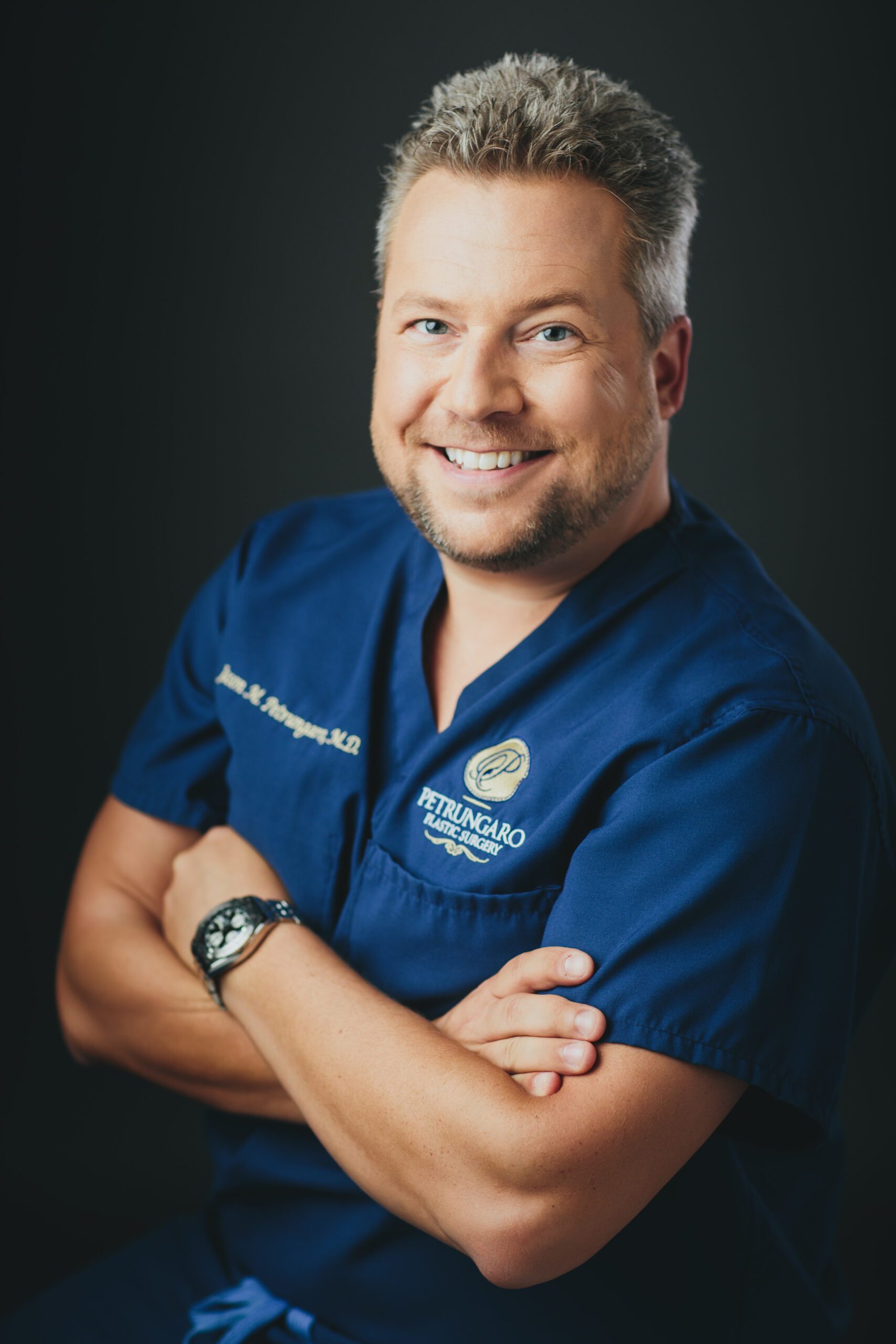
Successful Plastic Surgery isn’t just about what happens in the operating room; it’s about how you heal at home. It’s about planning, patience, and giving your body the grace it needs to recover. This is a core philosophy of award-winning board-certified Plastic Surgeon Dr. Jason Petrungaro. In his practice, patient education is paramount. He believes that a well-prepared patient is a happy patient, and understanding the recovery timeline is the key to a smooth, stress-free experience.
As the voted Best Cosmetic Surgeon in Northwest Indiana for 2024 and 2025, Dr. Petrungaro has guided thousands of patients through their transformations. His expertise goes beyond surgical precision; he helps patients navigate the logistical and emotional aspects of recovery, ensuring that their lifestyle aligns with their healing needs.
Let’s break down what you need to know to plan your surgery and your life around it.
The “Social Downtime” vs. “Physical Downtime”
One of the first things Dr. Jason Petrungaro discusses with patients is the difference between being “up and about” and being “camera ready.”
Physical Downtime refers to the period when you need to rest, avoid strain, and perhaps take prescription pain medication. For most procedures, this is surprisingly short—often just a few days to a week.
Social Downtime is the time it takes for swelling, bruising, and incisions to fade enough for you to feel comfortable at a dinner party, a wedding, or a work meeting. This is nearly always longer.
Understanding this distinction is vital for planning. If you have a major event like a daughter’s wedding or a high-stakes presentation, you don’t want to be squeezing into shapewear or concealing fresh bruising.
General Recovery Timelines by Procedure
While every patient heals differently, here are the general benchmarks Dr. Petrungaro advises his patients to consider when checking their calendars.
1. Breast Augmentation & Lifts
This is one of the most popular procedures, and thankfully, the recovery is relatively straightforward.
- Days 1-3: You’ll feel sore and tight. All patients will need help with heavy lifting (including kids!), but are mobile around the house.
- Week 1: Most patients return to desk work and driving (once off pain meds).
- Week 6: Clearance for all day-to-day activity and light gym work (NO CHEST EXERCISES).
- Week 12: Full clearance for all physical activity, including chest work and heavy weights.
- Planning Tip: If you have small children, arrange for help with lifting them for the first few weeks.
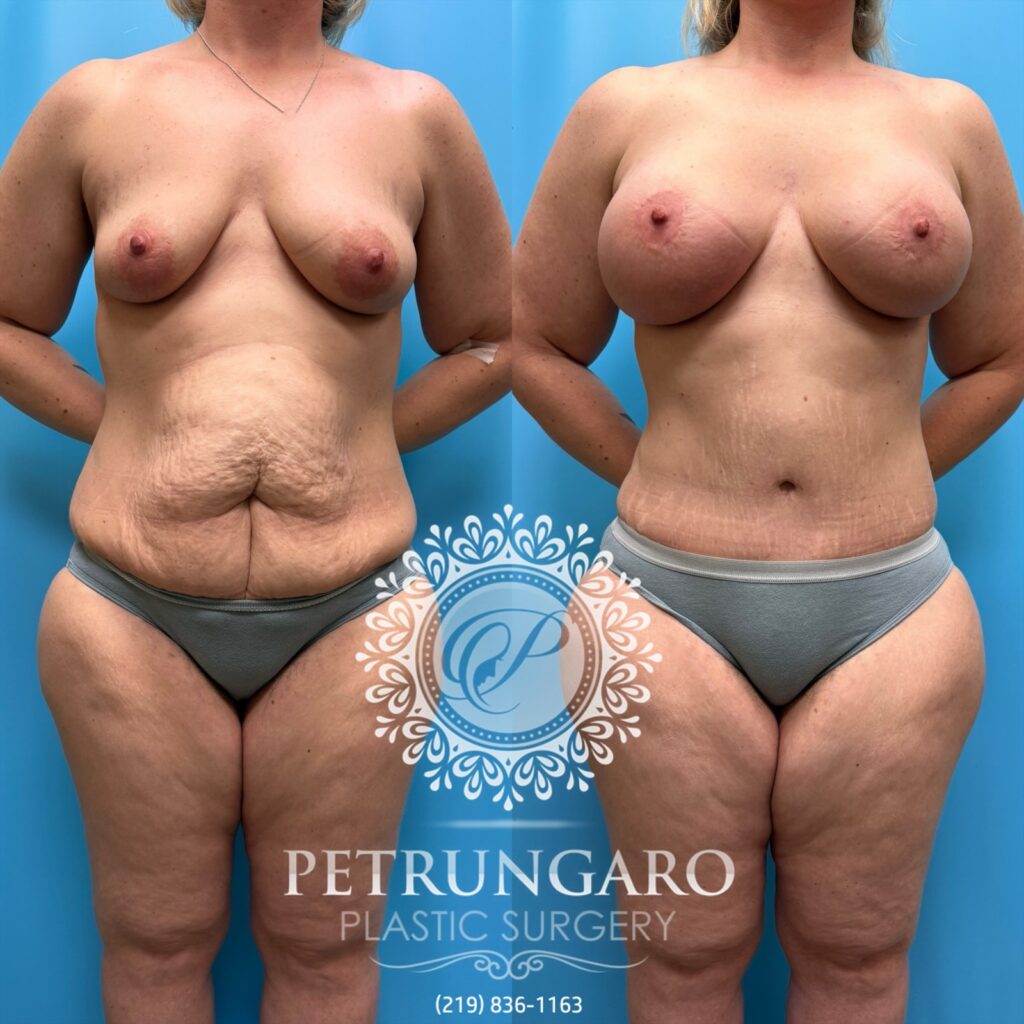
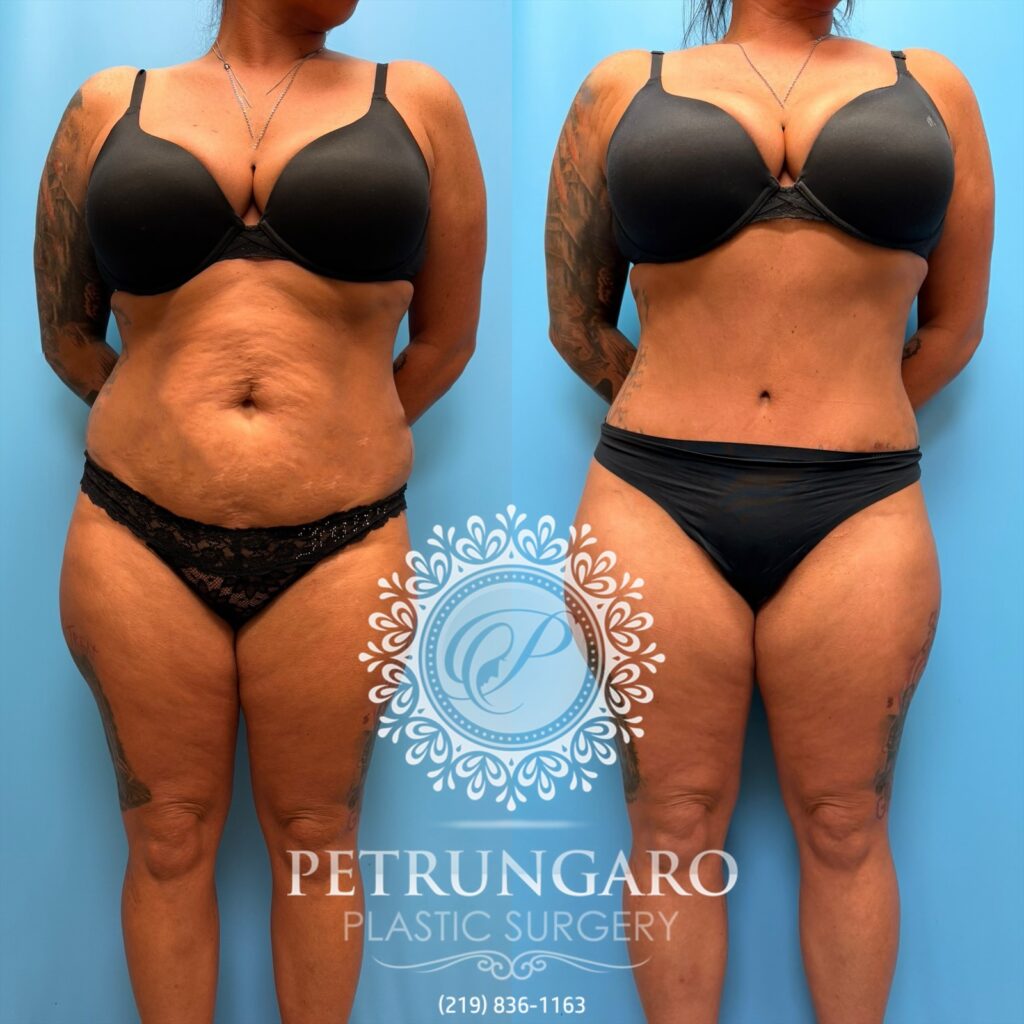
2. Tummy Tuck (Abdominoplasty)
Because this procedure involves muscle repair (tightening the core), the recovery is more involved than breast surgery.
- Week 1: You will need significant help at home. You may need to walk with a slight bend forward for the first 2-3 days. Pain and soreness will be the most significant at this time.
- Week 2: Most patients return to desk work, but stamina may still be low.
- Week 6: Swelling will still be present (and can fluctuate for months), but you can usually resume all day-to-day activity and light gym work (NO ABDOMINAL EXERCISES)
- Planning Tip: Dr. Petrungaro advises scheduling this when you have a solid 10-14 days to dedicate purely to rest. Do not plan a beach vacation for at least 2-3 months to allow the scar to mature and swelling to subside.
3. Mommy Makeover (Breast + Abdomen)
Combining procedures means combining recovery times. You are healing two major areas at once. The advantage: ONE recovery, albeit a bit more intense.
- Weeks 1-2: High level of support needed at home. You cannot lift anything heavier than a gallon of milk.
- Weeks 3-4: Energy returns, but you are still in compression garments.
- Planning Tip: This is a major logistical event. Meal prep, childcare, and pet care should be arranged well in advance.
4. Liposuction
Recovery depends heavily on the volume of fat removed and the number of areas treated.
- Days 1-3: You will be sore, like a very intense workout.
- Week 1: Most return to work. Bruising may be significant.
- Weeks 4-6: Swelling persists. The final results often aren’t fully visible for 3-6 months.
- Planning Tip: You will be wearing compression garments 24/7 for several weeks. Plan your wardrobe accordingly (loose, comfortable clothing is key).
5. Eyelid Surgery (Blepharoplasty)
This is where “social downtime” is the primary factor.
- Week 1: You will look “surgical” with obvious swelling and bruising. You likely won’t want to go out.
- Week 2: Stitches come out. Makeup can cover residual bruising. You might feel ready for a quick grocery run, but maybe not a gala.
- Week 4: Most patients look “restaurant-ready.”
- Planning Tip: Dr. Petrungaro suggests giving yourself a full month before any major photo-heavy events to ensure you look natural and relaxed, not swollen.
Lifestyle Considerations: The “Dr. Petrungaro” Checklist
Being voted the Best Cosmetic Surgeon in Northwest Indiana isn’t just about technique; it’s about holistic care. Dr. Jason Petrungaro emphasizes that your lifestyle choices during recovery directly impact your results.
1. Nicotine is a No-Go: This is non-negotiable. Nicotine constricts blood vessels, which can cause tissue death (necrosis), infection, and poor scarring. Dr. Petrungaro requires patients to be nicotine-free for at least 30 days before and 30 days after surgery. This includes vaping and patches.
2. Nutrition Matters: Your body needs fuel to rebuild tissue. Crash dieting before or after surgery to “maintain” the results is dangerous, putting you at risk for serious wound infections and poor scarring. You need high protein and hydration to heal. Dr. Petrungaro advises stocking your fridge with easy-to-digest, nutrient-dense foods before and after your surgery date.
3. The “Helper” Factor: You cannot do it all. Whether it’s a spouse, a parent, or a friend, you need a designated support person for the first 24-48 hours minimum. For procedures like a tummy tuck, you need help for longer. Be honest with your support system about what you will need—from driving you to appointments to helping you with drains.
4. Emotional Rollercoaster: There is a phenomenon known as the “post-op blues.” It usually hits around day 3 or 4. You’re uncomfortable, you haven’t seen the final results yet, and you’re tired. Some patients wonder, “Why did I do this?” This is normal. Dr. Petrungaro reminds patients that healing is not linear. Having realistic emotional expectations prevents panic during the recovery lull.
Why Choose Dr. Jason Petrungaro?
When you are planning a life event as significant as plastic surgery, you need a surgeon who is invested in your journey from the first consultation to the final follow-up.
Dr. Jason Petrungaro has built his practice on a foundation of trust and transparency. His back-to-back recognition as the top Cosmetic Surgeon in Northwest Indiana (2024 & 2025) is a testament to his consistency. He doesn’t just perform surgery; he partners with patients. He ensures you aren’t just physically ready for the operating room, but logistically ready for the recovery room.
His approach reduces anxiety. When you know exactly what to expect—when you can drive, when you can shower, when you can pick up your toddler—you can relax and focus on healing.
Planning Your Transformation
If you are considering Plastic Surgery, look at your calendar now. Is there a slow period at work? Do you have vacation time accrued? Can you enlist help from family?
The “perfect” time rarely exists, but a “well-planned” time does.
If you are in Northwest Indiana or the surrounding areas, Dr. Jason Petrungaro is ready to help you map out your journey. With his expert guidance, you can navigate recovery with confidence and emerge looking—and feeling—like the best version of yourself.

Q&A: Common Recovery Questions
1. How long do I have to take off work? This varies by job and procedure. For desk jobs, 1 week is standard for breast/body procedures, while 2 weeks is better for surgeries such as body lifts. If your job involves physical labor or lifting, you may need 4-6 weeks or modified duties.
2. When can I drive? You cannot drive while taking narcotic pain medication. Once you are off prescription pain relief and can move comfortably enough to react to traffic (check blind spots, stomp the brake), you are usually cleared. This is typically 5-10 days.
3. Will I have drains? For procedures like tummy tucks and breast reductions, yes. Many other procedures do NOT require drains. Drains prevent fluid buildup. Dr. Petrungaro will teach you how to care for them. They are usually removed within 1-2 weeks.
4. When can I shower? Usually 24-48 hours after surgery, unless you are in a specific garment or have specific dressings that must stay dry. Dr. Petrungaro provides very specific hygiene instructions for your first week.
5. How bad is the pain? Pain is subjective, but most patients describe it as “soreness” or “tightness” rather than acute pain. The first 3 days are the hardest, after which over-the-counter medication often suffices. Dr. Petrungaro uses advanced techniques, including long-acting local anesthetics, to minimize discomfort.
6. When will I see my final results? Patience is key. While you will see a difference immediately, swelling obscures the fine details. By 3 months, you see 80-90% of the result. For all surgeries, subtle swelling can persist for up to a year.
7. Can I exercise during recovery? Walking is encouraged immediately to prevent blood clots. However, cardio that raises your heart rate significantly should be avoided for 2-3 weeks to prevent bleeding. Heavy lifting is off-limits for 6 weeks.
8. What happens if I have a complication after hours? Dr. Petrungaro prioritizes patient safety. You will be given contact information or instructions on how to reach the medical team if you have urgent concerns like excessive bleeding or fever. He is personally available via his answering service 24 hours per day, so you will never need to worry about getting in touch if a complication or serious question arises.
9. Can I prepare my home to make recovery easier? Yes! Set up a “recovery station” near your bed with Gatorade, chargers, medications, lip balm, and entertainment. Place essentials at waist height so you don’t have to reach or bend.
10. Why is Dr. Petrungaro strictly out-of-network/private pay? By not accepting insurance, Dr. Petrungaro removes the barriers and restrictions insurance companies place on patient care. This ensures your surgical plan is dictated by your goals and his medical expertise, not an adjuster’s checklist. This focuses on the highest quality aesthetic and functional outcomes.